
This week I’ve made it to Siem Reap. A good 5.5 hours by bus from Phnom Penh. Day buses have become my go-to transport. I fully get that the night bus is more efficient on paper, but when I can’t sleep through a whole night, my following day is worth less too.
Besides, with a day bus I get to sit and look at the landscape. The story along the highway is very different. Big white cattle wander along the road and sometimes right out on it. The fields are surprisingly green, given how dry it’s been while I’ve been here. There are street stalls along basically the entire highway. You can pull over at any time and buy something to drink, food, and petrol. Of course they’re not big shops, just small tin sheds and tents.
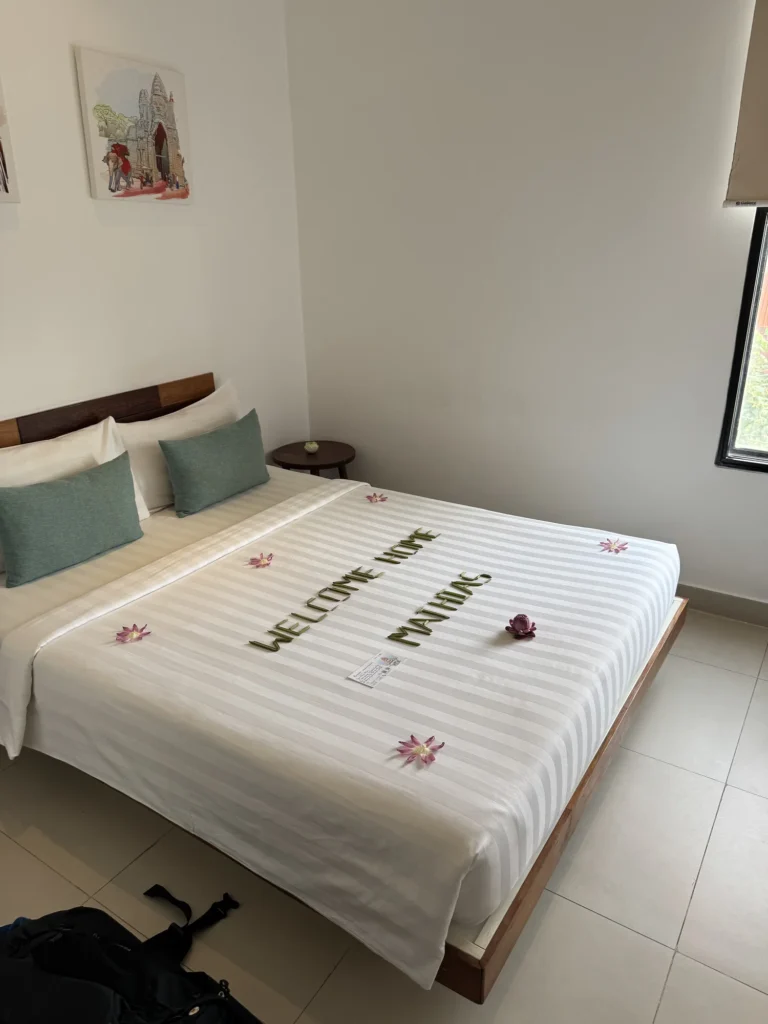
I arrived in Siem Reap a little after 15:00. That still gives me a whole evening to walk around and get my first impression. First I check in. The hostel, Onederz, is a very active and large hostel. 2 buildings split into 4 wings, with a bar, restaurant, and 3 pools. I have a private room, where I’m welcomed the moment I step into my room for the first time.
Siem Reap is a very different experience from Phnom Penh. I’m in the tourist center of Siem Reap, and there’s a very active town life, with plenty of varied cafés, restaurants, massage places, and markets. There’s a river running through town, which is both far cleaner than any other body of water I’ve seen in Southeast Asia, and also a gathering point full of life and activity. It’s swarming with tourists.
In the evening I come back to an argument from another world. Argument is maybe the wrong word, because it’s the young, very sour French woman shouting, banging on the table, and slamming the door. Then she stands out on the balcony talking on the phone for 10 minutes, before storming back in and continuing to chew out a tall young man. Rooms typically aren’t soundproofed in Southeast Asia because of the heat, but that also means you can hear everything happening in every room all the way down the hallway. Everything from arguments to nighttime commotion.
Floating village
My first day trip is a visit to a floating village. We’re a small group who set off in the morning and drive south out of town. The floating village sits on Southeast Asia’s largest freshwater lake, Tonlé Sap. The area where the village sits is flooded for half the year. That’s why the village’s buildings are mainly built on stilts 4+ meters high. May is the start of the rainy season, but it hasn’t really started raining yet, so the lakes and rivers are near their lowest. So we’re met with less floating village and more stilt-town.
We’re a small group of 6 Europeans. 3 Scots, 1 Brit, 1 German, and me. It’s pleasant company, and we have a good, lively chat throughout the whole trip. The two Scots are celebrating their 5th wedding anniversary, the third Scot and the Brit are two girls backpacking together, and the German is a solo traveler in his 40s. When we later have lunch, the Scots discover they live in the same area and have a long chat about selling dairy products to each other. It’s a small world.
We’re shown around the village. It’s an old-fashioned village. Between 3000 and 4000 residents, who mainly live off fishing and, on the side, tourism. It’s a village that guards its traditions. You can’t just move to the village without getting the mayor’s permission. That goes for shops too. Locals can sell out of coolers by the roadside, but there isn’t a 7-Eleven for miles around. Despite that, it doesn’t feel artificially kept alive. It’s just poor and basic. If it weren’t for the nice blue buildings on stilts, we could just as well have visited a slum area.
The internet has arrived in the village, which makes it hard for them to hold on to the young people, as well as to hold on to old traditions, such as forced marriage. There are many young people seeking opportunities either through education or jobs in the bigger cities. Very few come back. It’s not hard to tell the generations apart. Those who have a phone in hand, and those who don’t.
From the village we’re taken out onto the lake by boat. The lake is completely still. It’s overcast, so sky and water merge into one. In some places it looks like there’s a clear horizon line, but then you spot the flying boat. It’s a bit disorienting. We take a break at a floating restaurant. It was probably supposed to be lunch, but it ends up being just a couple of drinks and some snacks. It’s also one of the most expensive sodas I’ve had in Cambodia, so it didn’t make it easy for the stingy tourist.
From the lake we sailed back to the village and hopped straight on the bus back to Siem Reap. It was an interesting visit, and if I were a bit more of a writer, there was definitely a deeper story to be written about dying traditional communities, but you’ll have to make do with my superficial observations.
I’m going to visit Angkor Wat over the coming week. I’m really looking forward to it, but also quite unsure what to expect. You can buy multi-day access, which says something about the size of it. At the same time, Siem Reap has plenty of small nooks and crannies that I’m also looking forward to visiting. First impressions have been good, so I’m looking forward to my stay here.
Follow the journey
I'll send an email whenever new stories from the trip go up.
Want to support the journey? Read more here.