
The best experiences I have on my trip are when high expectations get surpassed. It has happened several times, and now again with Angkor Wat.
By the time I arrived in Siem Reap, I had already been told from all directions that Angkor Wat was a major sight. At the My Son ruins in Vietnam, Angkor Wat was referenced many times. You can’t walk past a tourist guide, or just down the street, without seeing ads to visit Angkor Wat. The Cambodian flag has Angkor Wat prominently placed in the middle of the flag. So all the signs of a big experience have been there the whole time.
At the hostel where I’m staying in Siem Reap, you can book many different tours to Angkor. The area is called Angkor and contains many temples spread across 400 km2. Access to Angkor is a lot like access to a large amusement park, with options for multi-day access, annual passes, and special access. I give myself three days to visit Angkor.
My first visit is by bike. It came as a suggestion from Eline, and it sounded like a really good way to get around. The bike tour is guided and together with an American and an Australian. They’re both solo travelers, and we quickly start chatting. Our bike tour is on some good mountain bikes, and we’re going to ride about 30 km, with 4 stops.
The bike ride is really fun. From Siem Reap to Angkor Wat there’s a paved bike path through the forest. The bike path doesn’t just plow straight through the jungle forest, but curves its way around in small arcs, turns, and hills. It ends up feeling almost like riding a roller coaster. The area is flat, so it’s not a hard route either.
After cycling for 20 minutes, we come to a small barrier where our tickets get scanned. From the barrier we cross a river, which turns out to be an excavated moat for the Angkor Wat temple. The river is at least 50 meters wide, and the scale of the area begins to sink in. On the other side of the river there’s a ruin. A big wall with a house in the middle. Every single stone is boulder-sized and covered in decorative patterns and depictions of gods. Some surfaces are worn down to nearly flat, while others still have depth in their engravings.
The cameras come out, and lots of pictures get taken while the guide talks. We’re all impressed. Our guide smiles. He’s clearly proud to be showing off his homeland. With a wry smile he reminds us that we’re standing looking at the gate. The temple itself is 200 meters further in. As we stand in the doorway, we can see the great temple dominate the horizon with its size. The trees along the path look small compared to the temple, until you give them enough attention to see that they’re old 400-500 year thick trunks, row upon row.
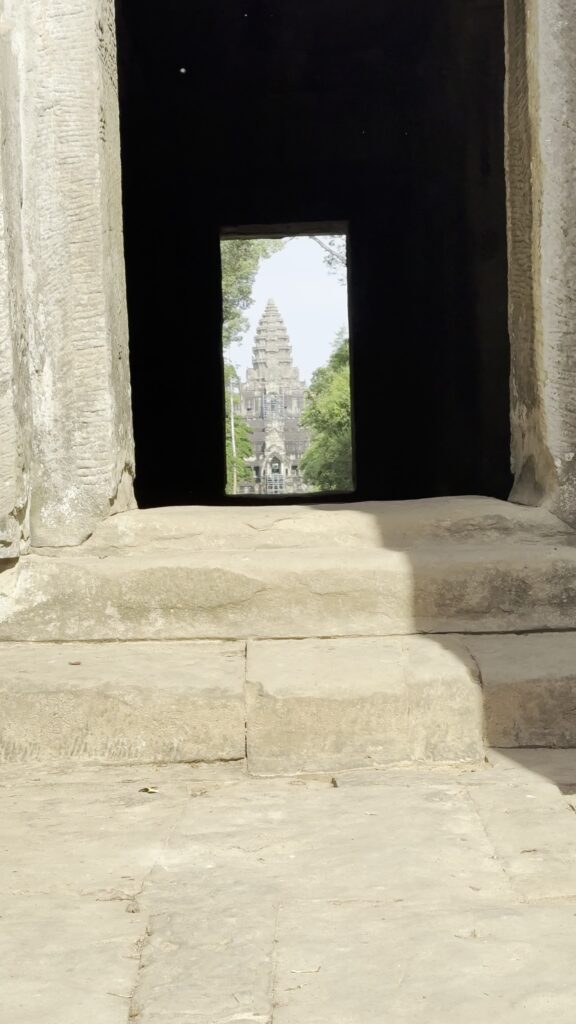
We move through the old forest towards Angkor Wat. Angkor Wat is an enormous temple complex. There are villages in Denmark that are smaller than this one temple. And the temple is 1000 years old. It’s not just huge stones stacked on top of each other. Most surfaces have engravings. The long 6-meter-high walls are covered from top to bottom with stories of Hindu gods. It’s all dressed in many hundred years of wear and decay, but still standing, still legible. Angkor Wat gives me a genuine and sincere feeling of grandeur.
We move up towards the top. Angkor Wat is a mausoleum, and the king is buried at the center. The stairs are uncomfortably steep, but for tourists some less steep stairs have been built. Up at the top we have a fantastic view. We arrived via the less-used east entrance, and we can now look out over the grand main entrance. A kilometer-long stone-paved road from the gate to the temple. The area has been cleared of trees and stands completely open. On the boulder-paved road, a stream of people moves from the parking area in towards the temple. Smaller ruins and palm trees can be seen scattered across the area.
On the way out of Angkor Wat we’re led to an entrance area, where the religious can come and pray to their gods or Buddha. Our guide has a big smile on his lips as he points to a large square stone in the floor in the middle of the room. He takes out his smartphone, opens the compass, points it north, and lays it along the stone in line with the floor’s dividing lines. The compass hits 0 degrees. The Australian is a civil engineer, and the American is a mechanical engineer. We’re all speechless. The stone is called the “center of the universe” and was one of the first stones laid, used as a reference line for the entire temple complex.
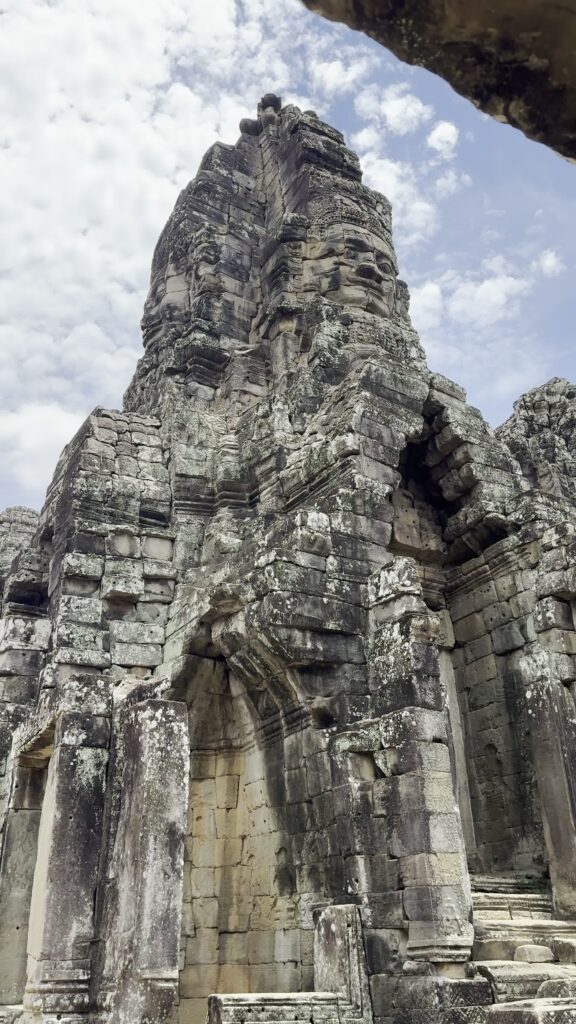
We cycle onward from Angkor Wat. I’m already quite satisfied with the trip, but we’ve only just started. Angkor Wat was built outside the central royal city, which we’re now heading to. The royal city covers a much larger area than Angkor Wat, with a bunch of small temples, an arena, and a large temple at the center. The large temple is called Bayon and is known for the towers with faces. 54 towers with 4 sides shaped as faces. Each tower symbolizes one of the 54 provinces and their guardian god that made up the Khmer Empire around the 1200s. You walk through a lot of small corridors, and every time you reach an open area and look up, there are faces looking back at you. Along the outer walls there are stories about society under the king who had the temple built. War with another kingdom of the time, Champa, trade with the Chinese. All kinds of small details about everyday things, like modes of transport, parasols, gambling, and children’s games.
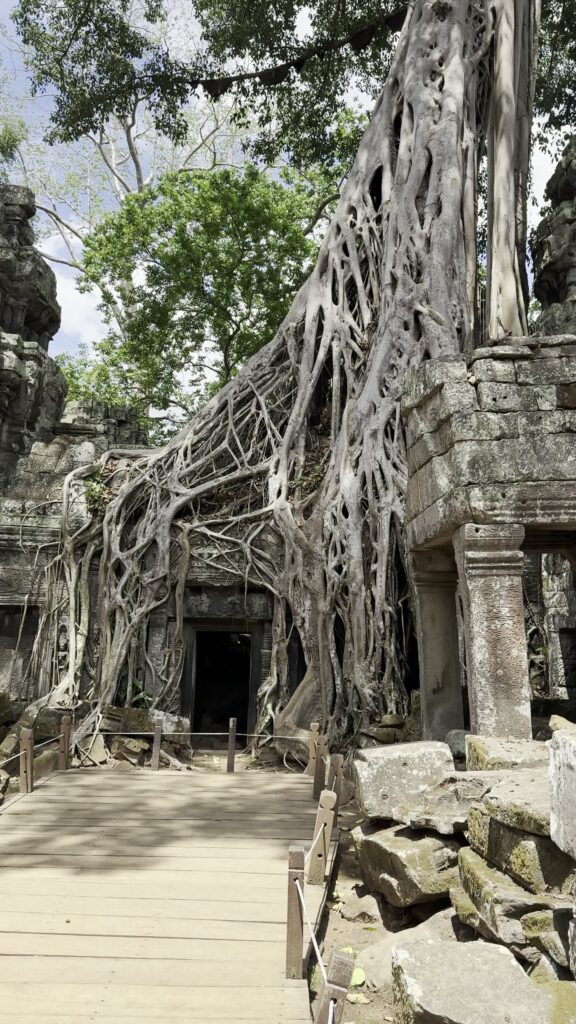
From Bayon we go to Ta Prohm, also known as the Tomb Raider ruins, where scenes from the 2001 film Tomb Raider with Angelina Jolie were filmed. We park the bikes by the road and walk in to the temple. Ta Prohm lies deep inside the jungle forest, reached by a broad gravel path, shaded by large trees and thickets. The temple itself is exactly the image I have in my head when I think jungle ruin. Trees have grown from the tops of the roofs and are now the load-bearing element for the rubble that’s still standing. The roots move down along the sides of the stone walls and cover windows and doors. The temple oozes history and adventure. If it weren’t for my current game project, I’d probably start a new one around this temple. Maybe I’ll work some ideas into my current project.
Ta Prohm is the last temple we visit. From here it’s lunch and back to Siem Reap. Our lunch is one huge platter of all sorts of dishes. As they carry it in, we start dividing up the dishes, until 2 more platters arrive. We sit with the food in front of us and look at each other. It’s way too much. The gesture is heartfelt, but we can’t eat 1/3 of the food in front of us. We collectively sit and hope our leftovers get given to someone else. The food is fantastic and it would be a shame to let it go to waste. As the platters are carried away, a dessert arrives for each of us.
The ride back to Siem Reap is fun, but potholed gravel roads and uneven paved paths also make it tough on the backside. We ride through a small town, through a forest path, over a river with bathing Cambodians, and down along the Siem Reap river. We meet many Cambodians on the way. Especially the children wave and shout “Hello” after us. When we get back to the bike shop, we’re treated to a big fruit drink with a whole clump of honey in it. While we drink the refreshment, we exchange contact info and photos. Both the American and the Australian have bought 3-day access to Angkor and are going back in the coming days. I decide to rent a bike, so I can just cycle around at my own pace and to my own destinations. There are still many temples and experiences to find in Angkor.
Follow the journey
I'll send an email whenever new stories from the trip go up.
Want to support the journey? Read more here.