
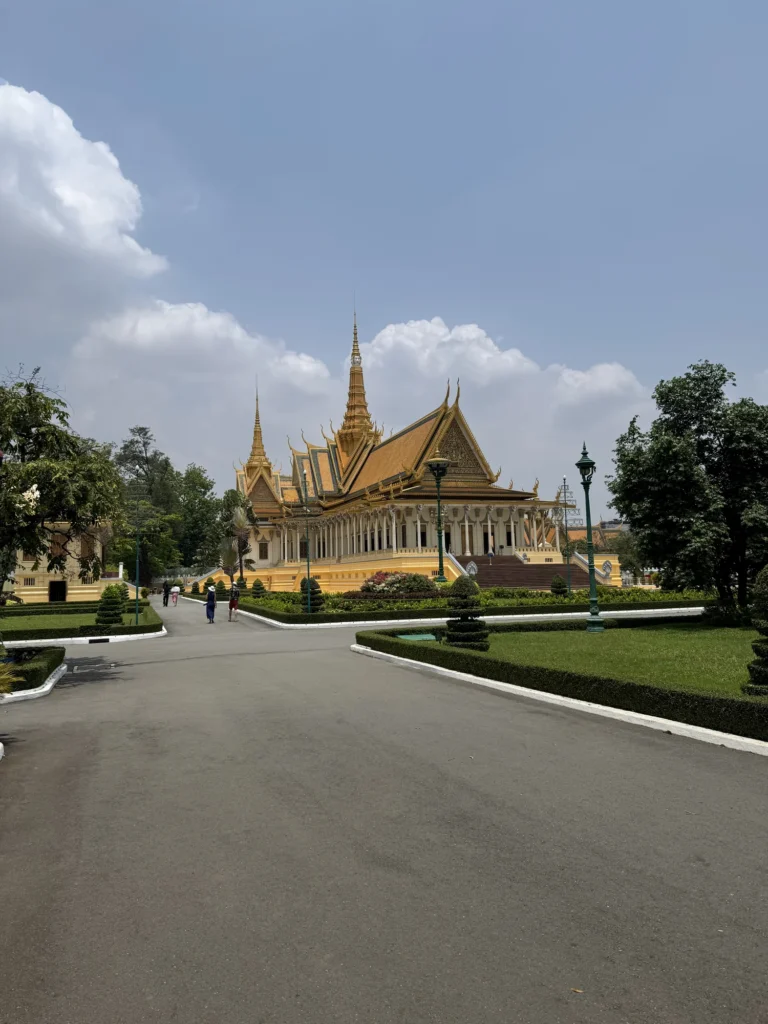
There are many villas, temples and palaces around where my hostel is. Buddhist temples, historical libraries, memorials, and the royal palace. As I walk the streets, there’s a jarring contrast between the gold-clad buildings and the visible poverty in the cityscape. Even the walls that enclose the private homes are ornate and decadent. Compared to Vietnam, the divide between rich and poor is more obvious here.
I’m on my way to the royal palace. There’s a large park out in front of the palace, which fills up with people in the evening. The public gathering place, where Cambodians come after work with their families to meet up and relax.
The palace grounds themselves are a walled-in city block in the middle of Phnom Penh. There’s an entry fee, with the option to pay extra for a guided tour. I pay the extra amount and get a guided tour.
My visit to the royal palace grounds is both well and poorly timed. It’s 11:30, no clouds, and the palace grounds are large, flat and open. We’re easily at 40 degrees, and I’m fairly sure you could fry an egg on the tiles. On the other hand, I have the palace grounds almost to myself. Few people are reckless enough to take on the midday sun.
My guide is a middle-aged man with fairly good English. I have him entirely to myself, so I use the opportunity to ask about a few different things alongside the stories about the palace.
The picture of the Cambodian royal house reminds me a lot of the Danish royal house. A modern royal house that has handed power to the people but still plays a large role in the social fabric. Not a divine bloodline, but nobility inherited through history. I see paintings and artworks, traditional uniforms, donated jewelry and personal belongings elevated to royal artefacts. It fits quite well with Buddhism as the primary religion.
The buildings, the ornamentation and the spiritual undertones are the most unique part. Cambodia has a very beautiful connection to its religious side, and it shows in every aspect. Everything from clothing and decorations to buildings and monuments is teeming with religious symbolism. My guide tells me about a mausoleum for a former king, which we’re standing in front of. It has a cone shape, and at the top there are 9 rings, which apparently symbolize the 9 heavens. But later, as we stand looking at a throne that also has a superstructure, there are only 6 rings. That still stands for the heavens, he says, you just need to count the 3 platforms the throne stands on as well. And then I’m also told that the 4 corners of the platforms correspond to the 4 elements. I don’t doubt my guide, but the symbolism and interpretation strike me as made up.
The last corridor before the tour ends holds a lot of pictures of the royal house together with other heads of state. Here I chat a bit with the guide about modern politics and the world. My guide has been incredibly friendly and kind throughout the whole tour, but his tone turns noticeably sharp and frustrated as he explains, from his perspective, how the world treats Cambodia. There’s a genuine sense that the world looks down on Cambodia, exerts pressure and makes unfair demands. According to him, Cambodia will become a major power in the region and internationally within just a few decades, and that’s exactly what the Western world fears.
We end the tour out by the gate. I thank him for his insight and his willingness to answer all my questions, including the ones not directly related to the palace. The palace was impressive, but it was the contrasts that left an impression. Between wealth and poverty, between symbolism and reality, between my own understanding and my guide’s.
Follow the journey
I'll send an email whenever new stories from the trip go up.
Want to support the journey? Read more here.