
Bali has everything a young, outgoing and tropics-loving person could need. Beautiful beaches, wild parties, an ocean of restaurants, all kinds of shops and services. It’s seductive. So it’s no surprise either that so many people stay a long time in Bali.
I’ve started to become well acquainted with Canggu. Everyday things like accommodation, laundry, ATMs, a hairdresser – I’ve got that sorted. I’ve found myself a set of places to eat with cheap, good food. As a rule, if you go for a Warung, you’ll find some cheap good food. The locals are happy to help too, since they typically eat at the cheaper restaurants as well.

Surfing
At the hostel and in Canggu generally, there are a lot of surfers. I’ve never surfed before. Nor skied, skateboarded, roller-skated, or done anything requiring too much balance. I believe I’ve ice-skated around before, but as I remember it, I only practised standing wobbly with one hand on the rail, plus the sitting position.
Nevertheless, it has to be tried, and one of the guys from the hostel is happy to give me a lesson. We meet down at the beach, where I’m dragged over to a stall and handed a surfboard. As a beginner I get a foam board. It’s easier to stand on, more stable in the water, but harder to manoeuvre. It’s big. Taller and wider than me.
We get in the water, and I start paddling. Mo, my instructor, says that most of surfing is about paddling. The more you paddle, the more waves you catch. Paddling is a bit of a workout in itself. You lie on the board, hold your upper body up, and rotate your arms. If your upper body and arms are too far down in the water, you don’t get very far very fast.
We’re out on the water for two hours. I get pushed off on 4–5 waves. Slowly but surely I go from lying down to standing, and standing in a crouch. Once you actually get going on a wave, it happens fast. You just get shot forward towards the beach. It feels strange to accelerate that quickly without an engine, but of course the wave is the engine. Riding the wave is pretty fun, but the longer you do it, the longer you have to paddle back. It took me 3–4 waves before I worked out that my instructor was jumping off before me for a reason.
It ended up being 2 hours of surfing. I’d come somewhat poorly prepared, with too little to drink and not enough eaten. Halfway through the surfing I could feel the lack of fluids, and by the time we hit 2 hours, there wasn’t a shred of energy left to paddle. But it was also a pretty good first experience of surfing, and definitely something I’d like to do again. Despite the bruises on my ribs, the worn skin on my legs, and the tired arms.
Scooter lesson
There are several places in Indonesia where it makes more sense to get around by scooter than on foot. Even though I always try feet-first, the distances to some areas are just too far. In many cases I could book a Grab driver, but there’s still a handful of situations where that isn’t practical either. So I’ve decided to try riding a scooter myself.
After moving around Southeast Asia for over 3 months, I feel fairly confident about the idea of riding the scooter myself. And to get off to a good start, I found a 2-hour mini course, where you’re briefly introduced to the scooter and go out riding with an instructor.
After doing figure-eights, backing up, stop-and-start exercises and emergency braking, we rode out into the busy Canggu afternoon traffic. You don’t ride very fast in Bali. The fastest I got up to was 35 km/h, and that was for a very short stretch. There’s both too much traffic and too poor roads to go faster. It’s important to keep an eye on those pulling out from shops and driveways. It’s often the case that scooter riders don’t look before pulling out onto the verge, picking up speed and merging in.
We ride around for 45 minutes through a long stretch of city. Again it strikes me that southern Bali is completely built up and packed with people. The road simply isn’t designed for the amount of traffic, and if you don’t ride a scooter, you can easily double your travel time.
But the riding lesson ends without any problems, and I feel fairly confident about renting a scooter and riding around from here.
Cosy evenings
The hostel is a good place to hang out. In the evening it’s a gathering spot. People gather around dinner, hang out and chat until around 9pm. Around 9pm there’s usually an evening activity, where people at the hostel are invited out to a bar, a place to eat, live music or something else.
I’ve joined several of the activities. I clearly prefer the live music. There’s a cosy atmosphere, and by now I’m fairly well acquainted with the musicians in the Canggu area. We’ve also been to a club a couple of times. It’s impossible to have a conversation, so I always end up just standing and dancing a bit to the music.
My evenings are pretty active here in Bali. At the same time, I get up later, work out in the morning, eat a late brunch/lunch, and usually have something on the schedule for the afternoon. It’s a bit reminiscent of everyday life. For now, though, it’s giving me something good and keeping me happy and content.
Work cafés
When Eline and I were in Ubud, I met a Taiwanese guy named Gary. He’s very chatty, a bit quick-witted, and has a slightly offbeat sense of humour. We had a nice time over a shared dinner and a couple of beers. When he mentioned he was heading to Canggu, I suggested Nyaman hostel to him, the place where we’re staying.
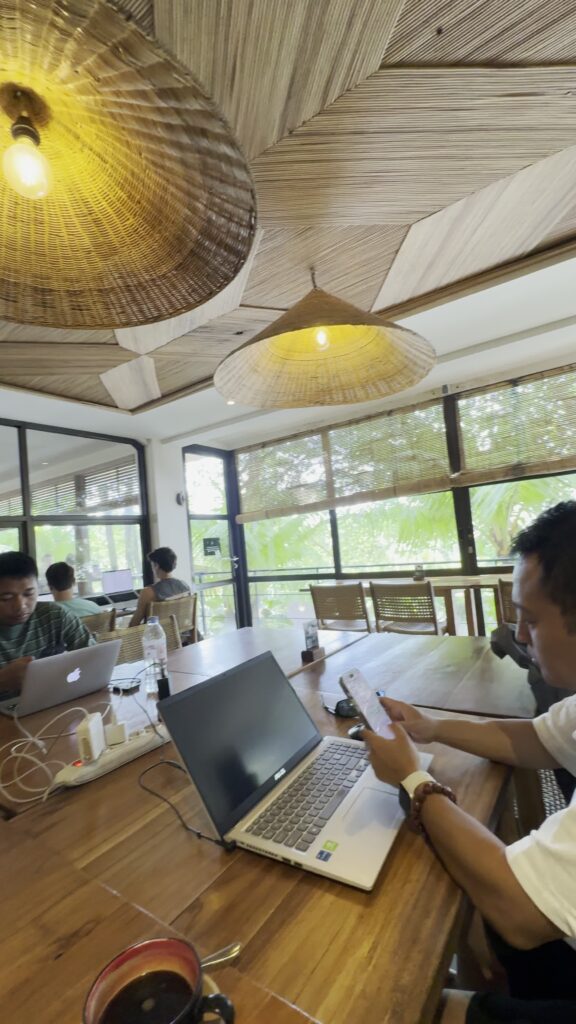
Gary arrived this week. He knows I like sitting with my computer, so after breakfast he took me to a work café that had been recommended to him. I’ve tried to find a good place to sit and work in Canggu, but it’s either expensive, too far away, or too busy. Gary’s café was pretty fitting and had most of what you’d need.
Eline also works from a work café. The concept is that you can sit in the café and get on the wifi if you buy something. You can also become a member with access to special quiet zones, meeting booths, free water, and much more. It’s actually quite a decent workspace you can set yourself up with there. The membership prices are a bit steep, though, and if I really wanted to get through a proper work session, I wouldn’t want to worry about how many hours I can and can’t spend in the quiet zone.
My little projects have gone and stagnated since I arrived in Canggu. I had an idea that I’d find my productive side here, but the opposite has happened. There’s always something you can join in on or have fun with. A good work café is only as good as how much you use it. For the past couple of weeks I’ve barely had my computer out on a daily basis, which is markedly different from when I was travelling around Vietnam and Cambodia. It’s not wrong or a problem. It’s just different, and not what I had expected.
Follow the journey
I'll send an email whenever new stories from the trip go up.
Want to support the journey? Read more here.