
DISCLAIMER: Contains heavy topics such as genocide and war crimes.
This is probably one of the hardest stories I’ve written so far.
For those who don’t know, a genocide took place in Cambodia from 1975 to 1979. A militant faction took over Phnom Penh and drove the city into flight. Around 2 million people were pushed out of their homes, out into the jungle. Over 4 years, around 1/4 of the country died.
Cambodia’s tragedy was fairly unknown to me before I set off on my trip. After some basic data about the scale and the list of war crimes, I had the overview. That didn’t make my visit any more comfortable.
S21 was a prison, and Killing Fields was one of many fields used for systematic executions. A day trip typically makes a stop at both. S21 is merciless in how it’s presented. You see the cells, the torture instruments, the gravestones and very graphic illustrations of the events. The numbers are incomprehensibly large. 18,000 in this one prison over 4 years. It’s just words for you as a reader, but I cried several times that day, just as I’m holding back tears now, remembering what I saw.
I remember being completely stunned when the tour was over. There simply wasn’t room for anything more in my head. An old man sat by the entrance selling books with his face on them. It was only on the way onward, when I talked with the others on the tour, that I understood the man was one of 12 who had survived S21. He was only a child at the time.
Killing Fields is located about a 30-minute drive from the city. Enough time to catch your breath a little. I’m traveling with a small group: a German, an Australian, an American, an Ethiopian and a Brit. I’m the oldest by almost 10 years. Along the way we talk with our Cambodian guide about differences in school systems and upbringing.
Killing Fields is a field with a few trees and a small lake. In the middle of the field there are small depressions. Mass graves. Over 8,000 people were executed here. In the middle of the field stands a large, thick tree. It’s covered with hundreds of small colorful bracelets. The tree is called the Killing Tree and was used to kill small children and babies.
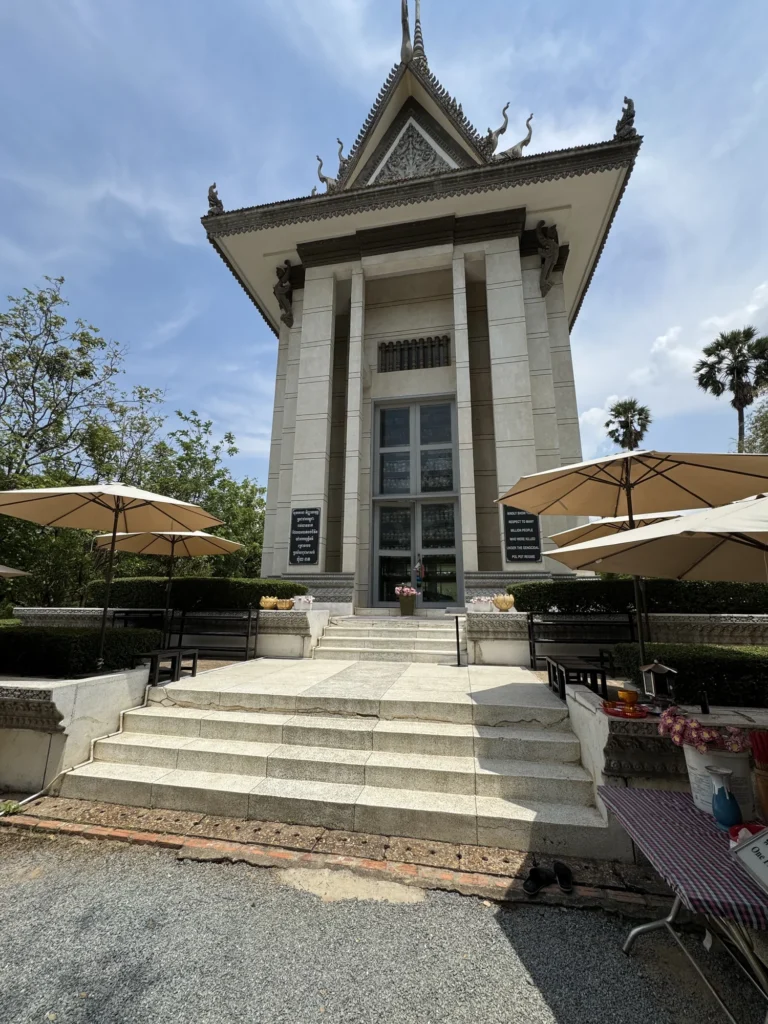
A large memorial and mausoleum has been erected in the middle. At some point it was decided to preserve the area rather than try to excavate all the victims. Bones and cloth from the victims slowly find their way to the surface. In one of the small depressions there’s a larger broken-off bone sticking out. Once a month they go through the area and remove what lies on the surface.
It was a day that has stayed with me, and has cast Cambodia in a very different light. It’s a country that has had to forgive the unforgivable in itself and each other, in order to stop the violence and put the tragedies behind it. For many adults it’s a lived reality, not a chapter in a history book. When I came to Cambodia from Vietnam, I could feel a visible shift in the general mood. Not depressed, but exhausted. Like a country that’s finding its energy and spirit again.
Follow the journey
I'll send an email whenever new stories from the trip go up.
Want to support the journey? Read more here.